Deterministic AI Agents in Mission-Critical Systems: Why Microfrontend Boundaries Matter
Learn how microfrontend architecture creates natural safety boundaries for AI agents in production. Reduce blast radius, increase determinism, and deploy AI reliably.
You've deployed an LLM agent to production to automate customer workflows. It's trained on your entire codebase, your entire state tree, your entire API surface. It works. Then it doesn't. It hallucinated a payment endpoint. It mutated shared state. The entire system broke.
Now imagine the same agent, but it can only see—and touch—a single bounded domain: the checkout flow. Same intelligence. Zero blast radius.
That's what microfrontend boundaries do for AI reliability.
The Determinism Problem: Why AI + Mission-Critical = Danger
Mission-critical systems live on a knife's edge. A payment system cannot fail. A healthcare workflow cannot guess. A financial settlement engine cannot hallucinate. These systems run monoliths or tightly-coupled architectures because the engineers who built them needed predictability—the certainty that, given X input, you get Y output, and nothing breaks state elsewhere.
Then we introduced LLM agents.
The promise is seductive: deploy an intelligent agent to automate entire business processes. Let it read your API docs, understand your domain, make decisions. But here's what actually happens:
State explosion. Your agent sees the entire application state tree. It has access to every domain, every service, every possible side effect. The surface area for error isn't just the agent's logic—it's the agent's logic multiplied by the complexity of your entire system.
Hallucination risk scales with scope. The more context an agent has, the more ways it can misinterpret that context. It reads a deprecated API endpoint and decides it's the primary one. It confuses a state variable in Module A with the similar one in Module B. The system is now in a broken state, and your entire platform is down.
Blast radius = system blast radius. If your agent goes wrong, and it can touch anything, it can break anything. Traditional unit tests and integration tests miss this because they test code, not agent decision-making under uncertainty. Your mission-critical system is now dependent on the stability of an AI model, not just your code.
Mission-critical environments demand determinism. They demand predictability. They demand architectural safety.
The Unbounded AI Agent: Today's Default Pattern
This is how most teams deploy AI agents today:
LLM Agent
    ↓
Full App Context (entire state tree, all APIs, all domains)
    ↓
Mission-Critical System (payment, auth, data warehouse, etc.)
Why? It's easier to implement. A single agent with unrestricted context is simpler to build than a scoped, boundary-aware one. You write fewer prompts. You deal with fewer API contracts. And in the early phases, it works.
Then you go to production.
The agent starts making decisions based on patterns it learned from your entire codebase. It mutates state it wasn't supposed to touch. It triggers side effects in systems it didn't know existed. Your tests pass. Your deployment succeeds. And six hours later, customer transactions are failing silently.
The real cost isn't the agent's intelligence—it's the agent's reach. An intelligent system with access to your entire platform is more dangerous than a dumb system with the same access. Because it will find edge cases, race conditions, and state inconsistencies that humans never thought to test.
Microfrontend Boundaries as AI Safety
Here's what most teams don't realize: microfrontend architectures solve this problem by accident.
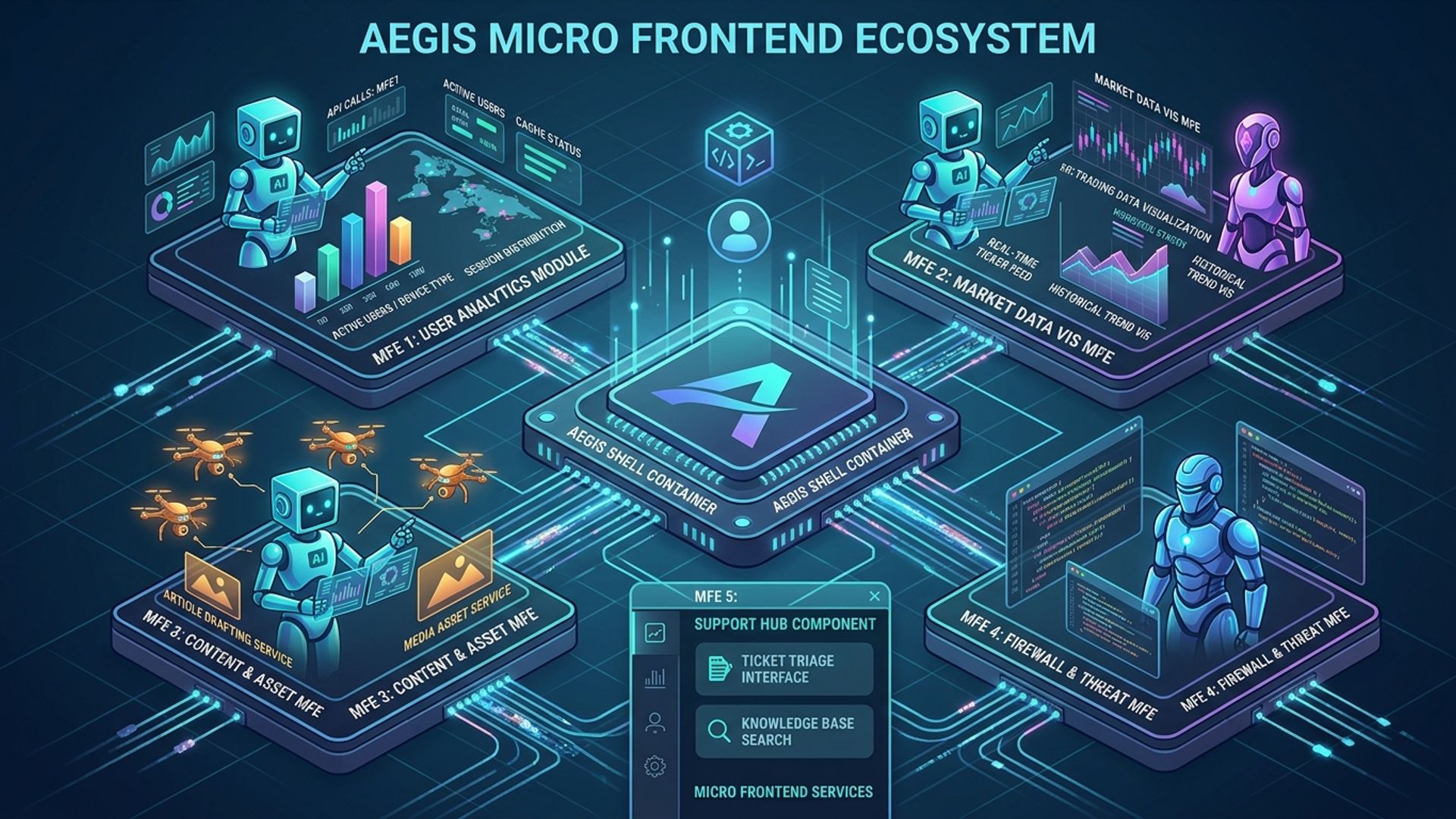
In a microfrontend system, each frontend module is a bounded domain. It has its own state management. It has its own API surface. It has an explicit contract with the rest of the system. The module doesn't see global state. It doesn't call arbitrary endpoints. It operates within a defined perimeter.
Now scope your AI agent to that same perimeter.
An agent running inside the checkout MFE:
- Can only see checkout state
- Can only call checkout APIs
- Can only modify checkout flows
- If it breaks, it breaks checkout—not the entire system
That's the pattern: agent boundary = MFE boundary.
The blast radius shrinks from "entire platform" to "single domain." Failure becomes containable. Recovery becomes predictable. Your mission-critical system survives.
Monolith vs. MFE-Scoped Agent: The Safety Trade-off
| Aspect | Monolith + Unbounded Agent | MFE + Scoped Agent |
|---|---|---|
| Context Surface | Entire system state + all APIs | Low (limited context = fewer interpretations) |
| Hallucination Risk | High (misinterpreting global patterns) | Low (limited context = fewer interpretations) |
| Blast Radius | System failure | Single MFE failure |
| Rollback Scope | Entire deployment | Single MFE (instant) |
| Testing Determinism | Hard (agent behavior influenced by global state) | Easy (agent behavior bounded by MFE contract) |
| On-call Wake-up Risk | 3 AM page for "agent broke everything" | Page only if checkout is down |
The trade-off is real: you lose some agent flexibility. It can't orchestrate across five systems. But you gain something more valuable: operational predictability in mission-critical systems.
Determinism Through Architectural Isolation
Bounded state isn't just safer—it's more predictable.
When an agent's context is limited to a single MFE, its behavior becomes testable. You can:
- Enumerate the state space. "What are all possible checkout states?" is answerable. "What are all possible system states?" is not.
- Define the API contract. "These are the three operations the agent can perform," not "the agent can call anything."
- Predict failure modes. You can reason about what happens when the agent misinterprets checkout data, because checkout data is bounded.
Determinism here means: given the same input, the same external conditions, and the same AI model, the agent will behave consistently. It won't have unexpected interactions with unrelated systems. It won't mutate state it wasn't supposed to touch.
In mission-critical systems, determinism is survival.
And when something does break—because it will—you can roll back instantly. Not the entire deployment. Not a ten-minute redeploy cycle. A single MFE, rolled back to the previous snapshot in 30 seconds.
The Infrastructure Layer: Deployment Reliability for AI
But there's a prerequisite: your microfrontend architecture needs to support instant rollback and canary releases.
This is where many teams fail. They have MFEs, but they can't deploy them independently. They can't roll back a single remote without touching the host application. They can't test a new agent version against 5% of users before the full rollout.
When your agent needs to be deployed, tested, and potentially rolled back—in production—you need deployment infrastructure that understands MFE semantics. Infrastructure that treats each MFE as an independently deployable unit with its own release cycle.
Orchestration of microfrontends isn't just about composition anymore. It's about supporting the operational requirements of AI-driven systems: rapid iteration, bounded scope, instant recovery.
Practical Checklist: Making Your Agents Deterministic
If you're running AI agents in a mission-critical environment, use this checklist:
- Define agent scope = MFE boundary
- Which single MFE will the agent operate within?
- Does the agent's use case fit entirely inside that boundary?
- If no, reconsider scoping or multi-agent orchestration.
- API contract = agent contract
- Document the exact APIs the agent can call (all of them)
- Document the exact state the agent can read (all of it)
- Make this contract explicit in prompts and system design
- State isolation validation
- Can the agent accidentally mutate state outside its MFE?
- Are there shared data structures it might corrupt?
- Test this explicitly; don't assume architectural isolation.
- Monitoring + rollback triggers
- Define what "agent went wrong" means for your domain (e.g., checkout completion rate drops 5%)
- Set up automated rollback triggers
- Test rollback in staging; verify it's actually fast
- Canary release for agent versions
- Deploy new agent versions to 5% of users first
- Monitor domain-specific metrics, not just error rates
- Rollback immediately if metrics degrade
- Graduate to full rollout only after confidence period
- Runbook for agent failure
- What do you do when the agent breaks?
- Who gets paged? When?
- How long does recovery take?
- Practice this in a staging environment.
Conclusion: Determinism as Architecture
The era of unbounded AI agents in production is ending. The era of scoped, boundary-aware, deterministic agents is beginning.
Microfrontend architectures give you the natural boundaries you need. They give you the architectural safety that mission-critical systems demand. But only if you treat them as such: not just as a way to split your frontend, but as a way to architect AI reliability.
Your agents are smarter than your code. They're also more unpredictable. Give them constraints. Give them boundaries. Give them MFE isolation.
Your mission-critical system will thank you when the agent's decision doesn't break the entire platform.