Project members and roles
A user can be a member of several projects, and a role is recorded for them in each one. That role is a label: it is stored, shown as a badge and named in the invitation email, but nothing in the platform reads it to decide whether an action is allowed. Inside a project, membership itself is the boundary — read the warning under Roles before you invite anybody.
Which projects a person can reach at all is decided one level up, by the organization that owns them:
The organization role answers which projects. Project membership answers whether this is one of them — and everybody who is in can do everything in it.
Two consequences are worth keeping in mind while reading the rest of this page:
- Whoever administers the organization reaches every project in it, invited or not. Somebody who must be read-only cannot be an organization owner or admin — and, per the warning below, cannot be a member of the project either.
- Inviting somebody to a project also puts them into the owning organization, as a plain member. See Inviting a member below.
Members live under Settings → Team Members.
Roles
:::danger Any role on a project grants full control of that project Every write inside a project goes through a single authorization check, and that check asks whether you are a member of the project — never which role you hold. A Viewer can invite members, rename the project and delete it, exactly as an Admin can. The console gates nothing either: the invite button and the Danger Zone render for every member.
So invite somebody to a project only if you would let them delete it. Somebody who must not be able to change a project cannot be given a role in it — put their work in a separate project instead. :::
The role exists as a label, and there are three of them:
| Role in the console | Stored and returned by the API as | Notes |
|---|---|---|
| Admin | OWNER | The last Admin of a project cannot be removed |
| Editor | MEMBER | |
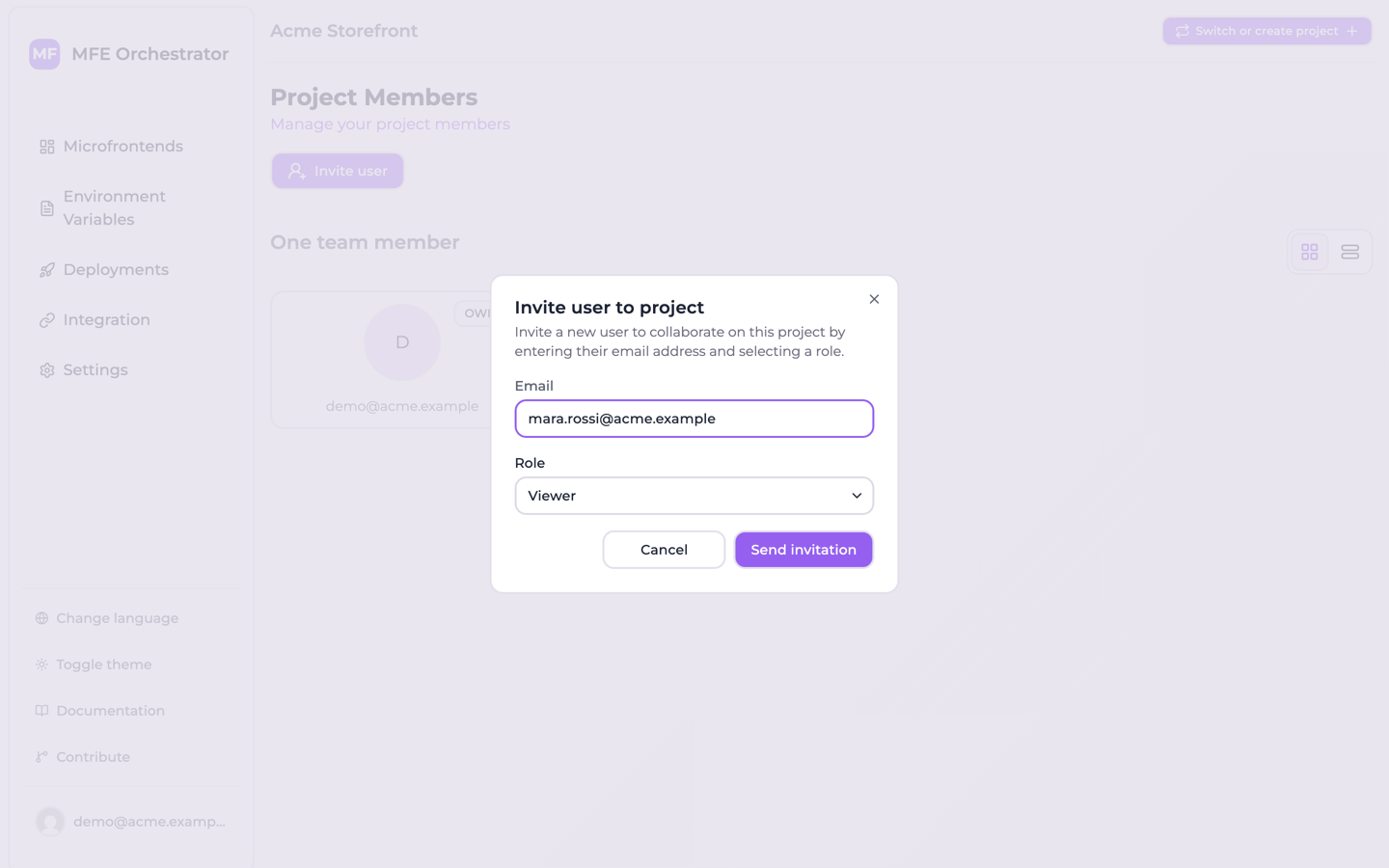
| Viewer | VIEWER | The value the invite dialog starts on |
The console is not consistent about which of the two names it shows. The invite dialog offers
Admin, Editor and Viewer; the badge on the members list prints the stored value — OWNER,
MEMBER or VIEWER — and so does the API. Invitation emails name the role as well.
The one thing the role decides
The last Admin is protected from removal: the API refuses to remove the final OWNER of a project,
and the console disables the button. That is the only outcome a project role changes. Renaming,
deleting, inviting, deploying, editing microfrontends, environments or variables: none of them
consult it.
Choose the role, then, as documentation of intent rather than as a control — it tells the next person who opens the members list what you meant this member to be. Keep at least two Admins, so the protection above cannot strand a project whose only Admin has left.
Restricting who can deploy to production
There is no way to do this inside one project. There is no per-environment permission split, and per
the warning above no per-role enforcement either, so an Editor and a Viewer can both deploy prod
as soon as they are members. The only mechanism that works today is a separate project for
production, whose membership is the smaller group. The ability to ship and the ability to
roll back travel together in any case: both are a
deployment.
Inviting a member
-
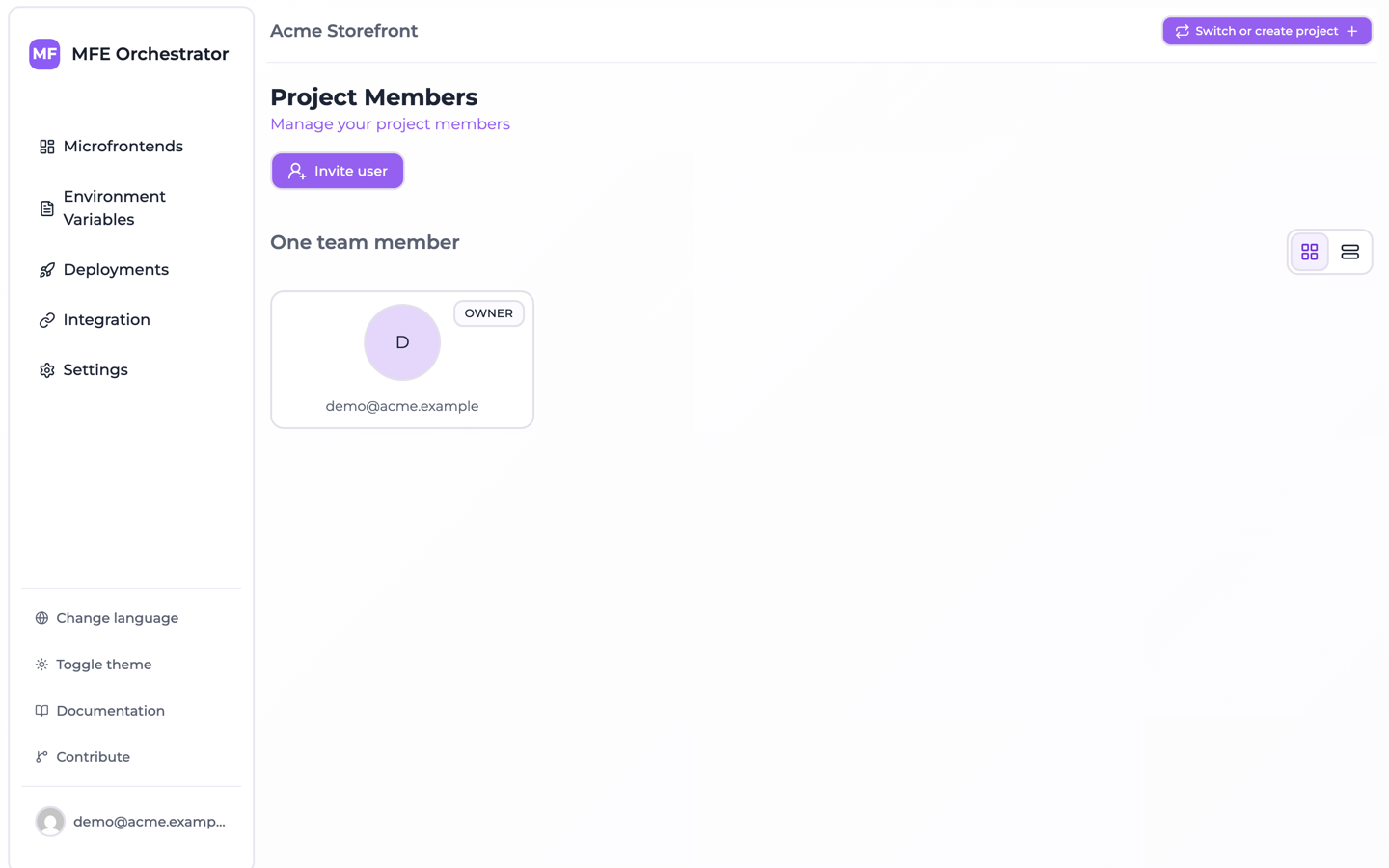
Go to Settings → Team Members and click Invite user.
-
Enter their email address.
-
Choose a role.
-
Send invitation.
An email goes out with an invitation link. The invitee follows it, signs in or registers, and joins the project with the role you chose — see Accepting an invitation for the screen they land on and how long the link lives.
:::info The invitation reaches the organization too A project sits inside an organization, so inviting somebody to a project also adds them to that organization — as a plain member, created already accepted. That membership grants nothing on its own: a plain member reaches only the projects they were invited to, which is exactly the project you just invited them to. Somebody who already holds a role in the organization keeps it; a project invitation never demotes an admin. Declining the invitation takes the implicit membership back again, unless they have other projects there. See Roles and project visibility. :::
:::caution Without SMTP an invitation becomes an unverified membership
Invitations are delivered by email, so the installation needs SMTP configured. On a self-hosted
instance without EMAIL_SMTP_HOST set the invitation does not fail — it degrades. No email is sent,
no link is generated, and the address you typed is added to the project as an already active
member, with nothing having proved that the person owns that address. Resending an invitation is
the only action that errors in that state.
Combined with the warning above, that means a typo hands full control of the project to whoever owns the address you mistyped. Configure SMTP before you invite anybody — see Environment Variables. :::
Managing invitations
Accepted members and pending invitations are two separate sections of the page, not one list with a status column:
| Section | Columns |
|---|---|
| Members — as cards, or as a table from the view switcher | User, Role, Actions |
| N pending invitations — the heading counts them, and appears only when there are any | Email, Role, Expires on, Actions |
An invitation expires five days after it is sent, which is the date under Expires on.
For a pending invitation you can:
- Resend — send the email again, for the classic case of it landing in spam. The only action with a visible label, and even that is hidden on a narrow window.
- Revoke — cancel it, so the link no longer works. An icon-only button: the ✕ at the end of the row, which names itself on hover.
Changing a role
Not from the console: the role is a read-only badge, and nothing in the interface writes it. The
management API does expose PUT /projects/:projectId/users/:userId, but no page calls it.
The one way through the interface is to invite the same address again while its invitation is still pending: that refreshes the pending row with the role you pick the second time, and sends a new link. Once an invitation has been accepted, re-inviting the address is refused as already a member.
Given that the role decides nothing, this is a cosmetic limitation rather than an operational one — but it does mean a badge can keep saying VIEWER about somebody you meant to promote.
Removing a member
Remove them from the row's actions — the trash icon in the table, the Remove button on the card. The confirmation is a plain dialog naming the person ("Are you sure you want to remove … from this project?"), not the type-the-name gesture that deleting a project asks for. The button is disabled for the last Admin, and when the project would be left with no members at all.
They lose access to this project immediately; their account and their membership of other projects are unaffected.
:::caution Removing them from the project does not remove them from the organization Somebody who accepted the invitation stays in the organization as a plain member with no project — harmless, since that grants nothing, but they remain on the organization's members list. Take them out from the organization page if you want them gone entirely; doing so also removes them from every other project of that organization. An invitation that was never accepted is cleaned up on its own when you revoke it. :::
:::tip Removing a person is not enough People leaving is also the moment to audit API keys. A key that person created keeps working after they are removed — keys belong to the project, not to the user who created one. Delete any key they were the only consumer of: deletion is the only thing that stops a key authenticating, as Machine access explains. :::
Authentication
How members sign in depends on the installation:
| Method | Notes |
|---|---|
| Email and password | Available when embedded login is enabled |
| Available when configured | |
| Microsoft Entra ID (Azure) | Available when configured |
| Auth0 | Available when configured |
The hosted console offers email/password and Google. For self-hosted installations, the enabled providers are whichever you configure — see Enable SSO.
Whichever method a user signs in with, their memberships are the same: authentication decides who they are, project membership decides which projects they reach.
Machine access
For CI pipelines and scripts, use API keys rather than a user account. A key belongs to the project, so it survives any change to your own account.
The create dialog asks for two things, a name and an expiration date; the role is not among
them, and every key the console creates is stored as MANAGER.
:::caution Only deleting a key stops it Authenticating a request looks the key up and checks nothing else — neither the stored status nor the expiry date is read. A key past its expiration date still works, and the Expired badge in the list is computed in your browser from that date alone. Delete is the only action that actually revokes a key. See API keys. :::
Creating a "service user" with a shared password is the anti-pattern here: it cannot be rotated without coordinating with everyone using it, and it muddies the audit trail.